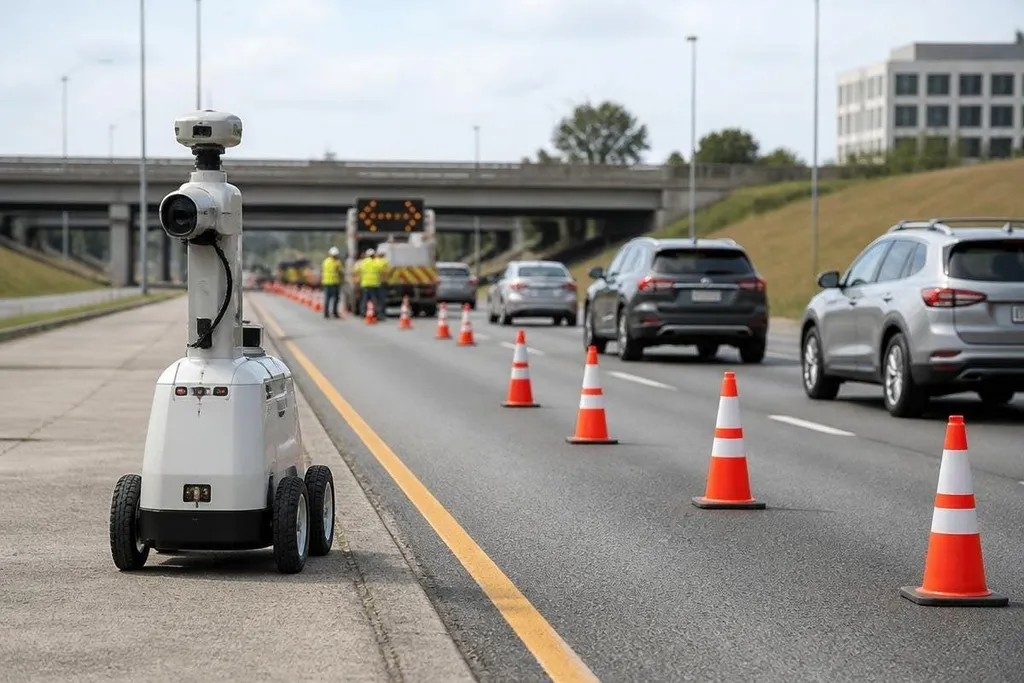
Traffic robots are moving beyond simple signal control. They can watch road conditions, inspect damaged surfaces, guide vehicles through work zones, or help traffic teams respond to blocked lanes.
Their value depends on the job. A robot that spots a stopped vehicle in seconds can help a control room act sooner, while a robot that only sends another alert may add little.
- Traffic robots work best on repeatable tasks with clear safety rules.
- Cameras, radar, LiDAR, and signal data give the system its view of the road.
- Human staff still need to handle unusual events and safety decisions.
What traffic robots actually do
The phrase covers more than one type of machine. Some systems stay beside the road and collect images or traffic counts. Others move through a site, inspect pavement, place signs, or guide vehicles around hazards.
A traffic robot starts with sensors. Cameras can record lane use and stopped vehicles. Radar measures motion and distance. LiDAR sends laser pulses to build a three-dimensional view of nearby objects. Signal data adds the state of traffic lights and crossing controls.
That information only helps after software turns it into a clear event. “A vehicle is blocking lane two” is useful. “The scene looks unusual” gives a traffic operator more work.
The best tasks have a fixed place, a known response, and a safe way to stop. Road inspection fits that pattern more easily than directing people during a major crash, where smoke, debris, police activity, and changing road closures can confuse the sensors.
Why roads need more machine support
Traffic teams have limited time and wide areas to cover. A person may need to check several junctions, tunnels, bridges, or work zones during one shift. A robot can collect the first set of observations at each site, leaving staff to confirm the finding and choose the response.
That split matters because traffic problems grow while teams are still finding them. A stalled vehicle can block a lane. A damaged sign can send drivers toward a closed road. A work-zone barrier in the wrong place can create a second hazard beside the first one.
That record also helps traffic teams check whether a robot caught a problem early or only documented the delay. Time-stamped images and sensor readings let staff compare normal traffic with an unusual pattern, then match the change to its time and place. Traffic robot reporting fromRobot24.com can add the machine’s task and test result before the next section weighs where these systems earn their cost.
The case for traffic robots is strongest where the work is dull, repeated, or unsafe for a person to perform near moving vehicles. That doesn't mean every road needs one. A small junction with a working signal and few incidents may gain little from extra hardware.
The limits are on the road, not the brochure
Outdoor traffic scenes change quickly. Rain can reduce camera visibility. Dust can affect sensors. Glare can hide lane markings. A robot may detect an object without knowing whether it is a fallen sign, a plastic sheet, or a person who needs help.
Connections can fail too. If a robot depends on a live link to a control room, the plan for lost communication must be clear. The machine needs a safe stop state, a local warning method, and a way for a person to take control.
Privacy also needs a firm rule. Road cameras may record vehicle plates, faces, and travel patterns. Operators should know what the system stores, how long it keeps the data, and who can view it. A useful traffic system can still be a poor public system if those answers are missing.
I'd support traffic robots for inspection and early warnings before I would trust them with full control of a live junction. The first job has a clear handoff to a person. The second can affect every driver, cyclist, and pedestrian nearby.
A practical buying check
Before a transport team approves a traffic robot, check these points:
- Name the task: Write down the exact event the robot must detect or action it must perform.
- Set the handoff: State when a human operator takes control and how fast that can happen.
- Test bad weather: Include rain, glare, dust, darkness, and blocked sensor views in the trial.
- Plan the failure state: Check what happens after a power loss, network loss, or sensor fault.
- Limit stored data: Set retention, access, and deletion rules before cameras go live.
- Measure the result: Compare response time, false alerts, staff hours, and safety events with the old process.
Traffic robots will matter most where they turn scattered road data into a clear action without hiding uncertainty. The next useful proof is not a polished demonstration. It is a named road site, a defined task, a failure record, and a result that traffic teams can check.